![KIN DENTAL CENTRE [CLEMENTI / WEST COAST]](https://kindentalcentre.com/wp-content/uploads/2021/10/colored-version-logo-horizontal_1-e1636957686352.png)
What is a Dental Implant?
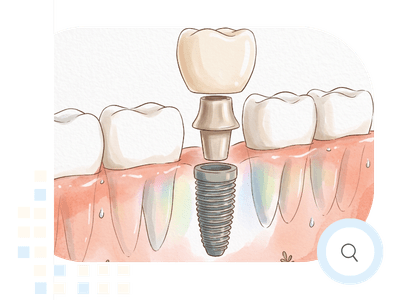
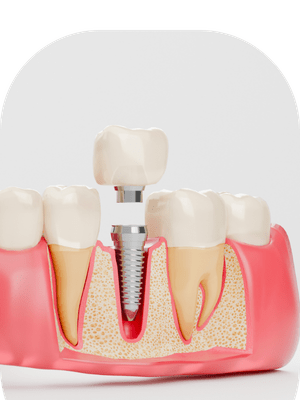
A dental implant is a titanium screw (the fixture) surgically placed into the jawbone to act as an artificial tooth root. Once the bone fuses around it — a process called osseointegration — a custom crown is attached on top, replicating the look and function of a natural tooth.
How does an implant differ from a bridge ?
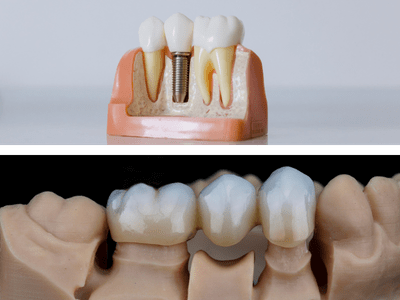
A bridge requires grinding down adjacent healthy teeth to support the replacement — implants do not. A denture sits on the gum and can shift; implants are fixed into bone and feel like natural teeth.
Crucially, implants also preserve the jawbone. Bone resorption (shrinkage) begins within months of losing a tooth and is halted by an implant, protecting the shape of your face over time.
Am I suitable for dental implants?
Most adults with good general and oral health are candidates. Key requirements include:
• Sufficient jawbone volume
• Healthy gums (active gum disease must be treated first)
• Well-controlled medical conditions
• Ideally being a non-smoker
A cone-beam CT scan (CBCT) is usually taken to assess bone volume precisely. If you have already lost bone, grafting procedures (socket preservation, sinus lift, guided bone regeneration) can rebuild lost bone before or at implant placement.
Medical conditions & smoking
Diabetes — Well-controlled (HbA1c < 7–8%) does not significantly increase failure rates; poorly controlled diabetes impairs healing.
Bisphosphonates (e.g. Fosamax for osteoporosis) — A small risk of jaw osteonecrosis (MRONJ) exists; a drug holiday or specialist liaison may be needed.
Radiotherapy to the jaw — Significantly increases risk; specialist assessment is required.
Anticoagulants / blood thinners — Usually manageable with liaison with your prescribing doctor.
Smoking — The single biggest modifiable risk factor. Smokers have roughly 2× higher failure rates. Stopping at least 1 week before and 8 weeks after surgery substantially reduces this risk.
Always disclose your full medical history and medication list at consultation.
What does the dental implant process involve?
(1) Consultation & Planning
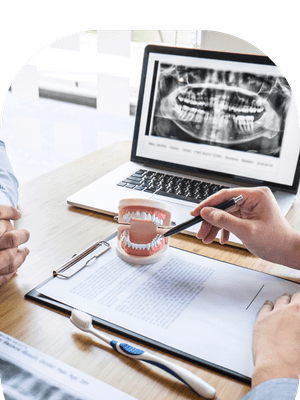
We begin with a thorough assessment including X-rays and scans to evaluate your bone volume, gum health, and bite. We will walk you through the full treatment plan, timeline, and a written quotation — so there are no surprises.
(2) Implant Placement & Healing
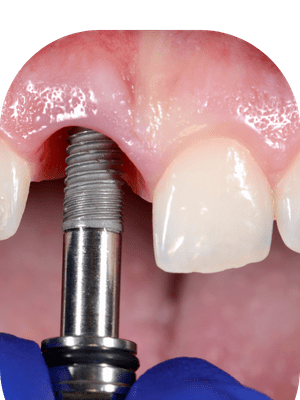
The titanium fixture is placed surgically under local anaesthesia. You will feel pressure but not sharp pain. Post-operative soreness and mild swelling are expected for 3–5 days, managed with standard painkillers. The bone then integrates with the implant (osseointegration) over 8–16 weeks.
(3) Crown Fitting & Final Result
Once osseointegration is confirmed, a small abutment is attached to the fixture and a custom porcelain crown is fabricated and fitted. The result looks, feels, and functions like a natural tooth. Total timeline: typically 3–6 months for straightforward cases; longer if bone grafting is required.
What does aftercare look like?
- Brush twice daily with a soft-bristle toothbrush, paying attention around the implant crown.
- Floss daily or use interdental brushes around the implant — peri-implantitis (infection around the implant) is largely preventable with diligent hygiene and is the leading cause of late implant failure.
- Attend regular professional scaling appointments every 6 months.
- Avoid biting on very hard objects such as ice or bones.
- Wear a night guard if you grind your teeth (bruxism), as excessive biting forces can stress the implant and crown.
- Avoid smoking — it is the leading modifiable risk factor for late implant failure.
What if I need multiple teeth replaced?
Options include:
Individual implants — one implant per missing tooth
Implant-supported bridge — two implants support a 3-unit bridge, replacing three adjacent teeth without the need for a third implant.
Full-arch rehabilitation (All-on-4 / All-on-6) — for extensive tooth loss, a complete upper or lower arch is supported by just 4 or 6 implants.
We will recommend the most appropriate option based on your bone volume, number of missing teeth, and treatment goals at your consultation.
How Much Does a Dental Implant Cost?
A single-tooth implant includes the titanium fixture, abutment, and porcelain crown. Pricing varies depending on the implant system used and whether additional procedures such as bone grafting or a sinus lift are required. We provide a detailed written quotation at your consultation so there are no surprises — please contact us to arrange an assessment.
Dental implants are generally claimable under Medisave for Singaporeans. Do contact us to discuss the most suitable and affordable treatment option for you.


Opening hours
Mon – Thurs : 9am to 9pm
Fri, Sat & Sun : 9am to 5pm
Closed on Public Holidays
Privacy Policy
Location
West Coast / Clementi Branch
505 West Coast Drive
#01-214 S120505
* Please Google Map to “Kin Dental Centre” – as the above location may have tracking error on the app
Contact Us
Call us @ 69797978 / 80221068

© Copyright 2024 . Kin Dental Pte Ltd All Rights Reserved

